I have been tagged by Joe Mahoney in a Blog Hop.
This means that I was interviewed about my writing process by Joe Mahoney here on my blog, because he was tagged and interviewed on his writing process on his blog by author/film-maker Susan Rodgers, who was interviewed about her writing process on her blog by Beryl Belsky who...well, you get the idea.
As a recording engineer for CBC Radio, Joe has recorded, mixed, and created sound effects for more than one hundred radio plays ranging from The Muckraker to Margaret Atwood’s The Handmaid’s Tale to Mordecai Richler’s Barney’s Version. Joe has also written radio plays (The Cold Equations, Captain’s Away!), produced them (Steve the Second), directed them (Canadia: 2056) and story-edited entire series (Steve the First, Steve the Second, Canadia: 2056.)
As a writer/producer, Joe has been a finalist twice for the Aurora Award, Canada’s top science fiction award (for Faster Than Light with Robert J. Sawyer and Six Impossible Things with Nalo Hopkinson) and won a Mark Time Silver Award for Best Science Fiction Audio Production of the Year 2005 (for Steve the Second). Joe is also a published author with several plays and short stories under his belt. He is also darned near finished his first novel.
These days when he's not writing he works as Manager of Digital Production Maintenance for CBC Radio & Television and lives in Whitby, Ontario with his wife and two children.
These are Joe's questions to me:
Joe: You wear many hats. You're recently retired from the University of Lethbridge, where you had a successful career as a sociology professor. You're also a writer of speculative fiction, an editor, an essayist, a reviewer, and a family man. How have you found the time to write? How do all of your activities and interests inform your writing, fiction and otherwise?
Robert: The short answer would be that I mostly can't find the time to write.
Writers like to have blocks of free time to just think / write, and I haven't had that anytime in the last 30 years. The reality is that almost no one makes a living writing fiction these days, so most of us have to devote time and effort to our day jobs, and I chose a career that places a lot of demands on one's time. That lesson plan has to be ready when the class is scheduled to start, so lesson planning and marking and advising students have to take precedence over one's own writing. And publish or perish is a reality in my line of work, so research necessarily took much of my after hours time. You can't say to your students, or to your Dean, or to your own kids, "I'm sorry, I can't do that right now, I'm working on my novel." Even taking early retirement to free up time for writing hasn't been entirely successful because my editing work just expanded to fill that time, and because there is always more you should be doing for family—the work expands to fill the time available.
I tried using NaNoWriMo to get down on paper one of several novels that had been floating around my head for years. I would think my way through stories while walking the dog or washing the dishes or otherwise having a quiet moment, but that's just daydreaming unless you can get it down on paper. But November is a busy month for anyone in academia, so NaNoWriMo is not entirely suitable. So my wife started organizing writing retreats at other times of the year for me. I usually can only get away for ten days or so, but that's been enough to allow me to get out a story a year and to have made real progress on my first novel.
I take my inspiration here from H. A. Hargreaves, whose collection of short stories was the first ever marketed as Canadian SF (North by 2000; reprinted in expanded edition in 2012 as North by 2000+).
Hargreaves could only budget one or two weeks a year to write, but over the course of his lifetime he produced a significant body of work and was a major influence on other Canadian SF writers. The idea that one has to write full-time to be taken seriously is a mistake. It's quality not quantity that should matter. I wish I had more time to write, but I also love editing and teaching and researching and parenting, and so on. I write when I can find time, and that just has to be enough.
As for the second question, I think all writing, if it is any good, is influenced by the author's daily activities. My most recent short story, for example, is about a teacher talking to students as they line up to leave the classroom. It's right out of my daily experience as both a parent waiting to collect my child and as a teacher-trainer. Similarly, even though my novel is old-fashioned SF and I've never lived on a spaceship, the characters and relationships are pretty much right out of my life.
Of course, my writing is heavily influenced by life as a reviewer, critic and editor. I've been very conscious in my writing of not making the mistakes I see in other SF. For example, it's always driven me crazy when the hero breaks into the alien space ship and simply announces, "these must be the warp drive controls", or looks at a couple of buildings and immediately deduces correctly that the aliens are part of a hive mind, or solves the central mystery of the book on the first try. So I made sure my characters get things wrong all the time and make the sort of mistakes people actually make when confronted with new information. And so on. Of course, in avoiding the usual clichés I have undoubtedly invented a whole new range of mistakes of my own....
Joe: You're currently putting the finishing touches on your science fiction novel, The Flight of the Illynov. At the same time you're editing for Five Rivers Publishing. How does the editing part of you get along with the writing part of you? How does it help or hurt the writing process having that editing experience and knowledge?
Robert: Having experience as an editor, I can edit my work as I go, so that allows me to avoid a lot of the usual errors, but I also have to be careful to turn my own editor off from time to time, particularly in the early stages of writing when a book or story is still relatively fragile. As an editor, one has to be able to look past a manuscript as it is and see what it might be. That's even more true for one's own work. There's a temptation to say, "this isn't that good" and give up on it rather than to try to make it better, but the truth is, no first draft is any good; it's always about the rewriting. Being too critical too early is always a mistake.
I wrote a column last year on what it was like to send my manuscript off to an editor, both knowing that every manuscript needs to be edited, and secretly hoping that my manuscript would be the exception. It wasn't!

Joe: What have been your biggest challenges writing The Flight of the Illynov?
Robert: Besides the ever-present problem of finding the time to work on it, the fundamental problem with my novel is that after the first 70 pages or so of action, I stuck my characters on a spaceship for a year and a half. I don't know what I was thinking. Because sitting around talking in the ship's mess for 200 pages does not leave a lot of room for action. All my characters ever want to do is talk. I tried blowing up their world, having them arrested, blowing up their ship, having them arrested by the other side, blowing up their ship again, starting a war, but whatever I did, the protagonists just tries to talk his way out of it. So I worry that it's too much talking heads, that it drags in places. But I'm working on that.
Joe: What is your writing process? Do you have a set time and place to write, or any writing rituals that need to be in place? Do you ever find yourself procrastinating and if so, what do you do about it?
Robert: I used to procrastinate a lot, but I don't have time for that anymore. If my wife books a retreat for me, that's a lot of family time and money riding on my being productive, and it's my one shot at writing uninterrupted for the year. So I pretty much have to get on with it.
In terms of place, what happened was I wanted to go to a retreat at the Banff Center that Robert Sawyer was leading, but there was a death in the family that year, so that just didn't happen for me. The next year the retreat leader was a wonderful poet, but frankly, my novel is about story and humour, not poetical language, so I wasn't sure that would be the right retreat for my manuscript. And my wife looked at the fees and said, "That's a lot of money if you're not sure about the workshop aspect. Hell, I could put you on a cruise for a quarter of price, if you just want time to write." And we looked at each other, and I said, "Um, okay." So ever since I go on a cruise by myself each year. I take an inside cabin so it's both cheap and dark—I want dark so I can sleep whenever I run out of steam, and write as late as a like. I frequently work round the clock. When I was writing the scenes on the spaceship, my wife booked me into the cabin next to the engine room—the unceasing beat of the engines made for appropriate atmosphere for my writing about life on a spaceship! But the best thing is, there is great food available around the clock, much better than at any retreat. And when I want to stretch my legs, there is the track on the deck or a quick walk around whatever port we happen to be in that day. So that works pretty well.
My biggest problem with writing rituals is that when I pause to work out some problem in a scene, whether I am on a cruise or stealing an hour at work, I take that break by going for a snack. That's never a good idea, healthwise. So I am trying to substitute either a jog around the deck or a mug of tea. My favorite tea is David's Chocolate Chili Chai or Mighty Leaf Vanilla. That's almost as good as a snack.
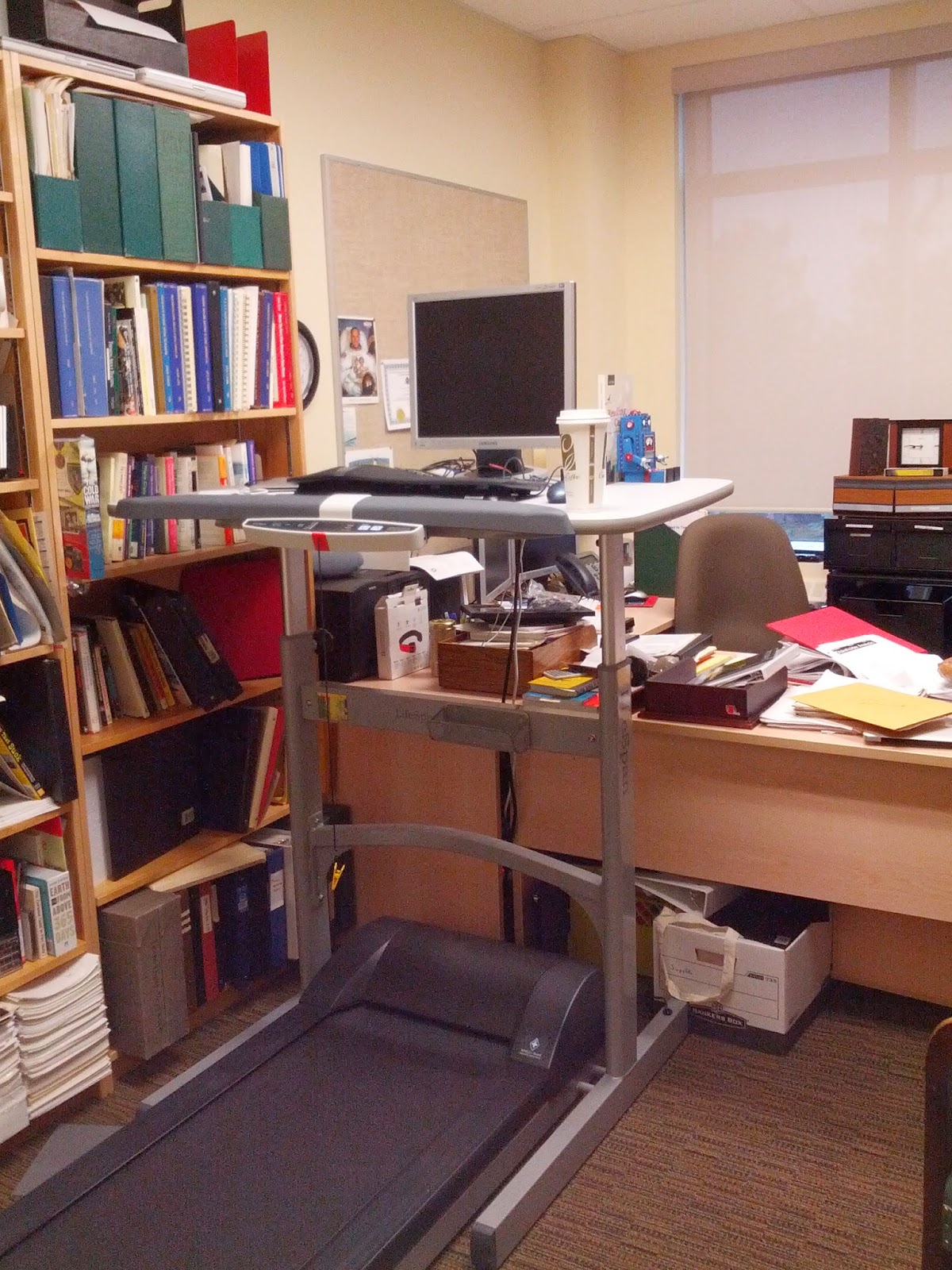
At work I have a treadmill desk, so I am walking all the time I am writing. That's working really well for keeping energy up.
Joe: As an editor, you know that professional writers, although skilled in their trade, still require editors. In your experience, what do professional writers typically get wrong that editors like you can help them with?
Robert:I've tried writing about the most common errors I encounter in my blog here, so I've already covered some of that: starting the story too early; forgetting that "less is more"; mistaking physical descriptions for characterization; and so on. But the truth is, every author has particular strengths and weaknesses, so all the advice columns in the world can only help so much. You see some manuscripts where the author is totally abusing adverbs, and so you get some American editors/writers (e.g., Stephen King) making the ridiculous pronouncement that, "adverbs are always bad". And then I get manuscripts where the writing fails because the writer has lost what is actually an important part of speech—that manuscript could actually have benefited from the insertion of a couple of adverbs. Practically any advice I have given to one author turns out to be the exact opposite of what I need say to another. You need to actually have an editor to tell you whether your problem is that you are too verbose or overly concise; too much description or too sparse; too much explanation or too little. It's hard to judge these things for oneself, to tell whether the pacing is working or the mystery is too obvious or whatever. For beginning writers, some general do's and don'ts might be helpful— The Turkey City Lexicon is still the best resource for beginning SF writers—but for professional writers it's hard to suggest one-size-fits-all advice. With published authors, it's largely either a question of identifying some logical loophole they've missed or a matter of refinement. Either way, the problems are going to be specific to that author or manuscript, rather than something that can be generalized.
Joe: When do you anticipate finishing The Flight of the Illynov? And what's next after that?
Robert:It's hard to say when. There are probably only a couple of week's work left on Flight of the Illynov, but depends when I can free up two weeks to do it. I would really like to be done, but I feel guilty how far behind I am on my editing. I can't stand the thought that other people's careers are on hold until I finish with their manuscripts, so I always priorize editing responsibilities over my own writing. (I know that Lorina Stephens, the publisher at Five Rivers, suffers from the same problem, so that her own writing ends up at the bottom of the to do list.) But I have long suspected that I am a better editor than I am a writer, so that's probably just as well.
Nevertheless, I have two new novels on the go now. The one I intended to do next, on which I made a start while awaiting feedback from my editor; and a completely new idea that just popped into my head two weeks ago but which I was inspired to start on right away. The later is tentatively titled, Semi-Posthumously and would be loosely based on my observations visiting my mom in an old age home, so it's not SF at all. And I have three or four short stories in various stages of completion. And a 'how to' book on examination construction based on my career as a test development specialist...and a book on Canadian SF, and... well you get the idea. Too many projects, too little time.
Here are the two bloggers I've tagged:

Mike Plested
Michell (Mike) Plested is an author, editor, blogger and podcaster living in Calgary, Alberta, Canada. He is the host of several podcasts including Get Published, (2009, 2011 and 2013 Parsec Finalist), the SciFi/Comedy GalaxyBillies (Hitchiker’s Guide to the Galaxy meets Beverley Hillbillies) and Boyscouts of the Apocalypse (Zombie horror meets boyscouts), a part of the Action Pack Podcast.
His debut novel, Mik Murdoch, Boy Superhero was published August 1, 2012 and was shortlisted for the Prix Aurora Award for Best YA Novel. The sequel, Mik Murdoch: The Power Within, is due out August of 2014.
* * * * * * * * * *

Michael Matheson
Michael Matheson is a gender-fluid Toronto (the Canadian one) writer, poet, editor, anthologist, and book reviewer. A Managing Editor (CZP eBooks) with ChiZine Publications, and a Submissions Editor with Apex Magazine, Michael is editing three anthologies for 2015 (Start a Revolution, Exile Editions, Spring 2015; This Patchwork Flesh, Exile Editions, Fall 2015; The Humanity of Monsters, ChiZine Publications, Fall 2015). Michael's own fiction and poetry are published or forthcoming in a number of venues, including Ideomancer, and the anthologies Chilling Tales 2, Dead North, Fractured, Future Lovecraft, Masked Mosaic, and more. The in depth interview on Michael's writing process raises a number of significant issues for readers and writers.