
Writing advice and commentary from the editors at Essential Edits / SFeditor.ca
Saturday, June 30, 2012

Friday, June 22, 2012
"Split Decision" Reprinted
Pleased to hear that my short story, "Split Decision", originally published in the Tesseracts 15 anthology, has been picked up by Imaginarium "best Canadian SF of the year" anthology.


Tuesday, June 19, 2012
Choosing an Editor
Excellent advice on how to choose suitable editor, on SFWA Facebook page:
http://www.facebook.com/notes/science-fiction-and-fantasy-writers-of-america/vetting-an-independent-editor/10150929453034874
Thursday, May 31, 2012
Mike Plested talks Publishing / Promotion
Mike Plested "Get Published" Podcast, episode 84, talks about publishing and book promotion. Usually Mike interviews authors and editors on his biweekly podcast, but this time he is the interviewee, talking about his own new book, Mik Murdoch: Boy Superhero. Mike describes the process of writing the novel, shopping it around to publishers, the editing process, and post-publication promotion. I was particularly interested in his discussion of why he chose to sign on with a publisher rather than just self-publishing, and what it was like working with an editor.


(Particularly glad to hear him say complimentary things about the latter, since I was the editor on this book.)
Saturday, May 12, 2012
Five Twitter Turn Offs
Got yet another person following me on Twitter, in hopes that I will immediately follow back. A quick glance shows me that this individual has accumulated around 8,000 followers...and follows over 8,000 other people. I'm guessing almost all of them are working on the same wrong-headed principle that the more followers one attracts -- the larger that number -- the better one's networking and sales potential. This is completely stupid and an enormous waste of one's energy.
Rule #1: More is Not Better
8,000 followers does not translate to 8,000 network connections. If each of these averages 3 tweets a day, that's 24,000 tweets going past each day. If one is spending one's day reading 24,000 tweets, then one is a professional Tweet reader, not a professional writer. Since one would have to be a complete time-wasting idiot to read all that chatter, you don't. Since you know better than to read all those tweets, who do you think is reading yours?
Time invested in building up a following -- particularly in artificially inflating that figure by using the tricks one read in some self-appointed expert's column on how to use social media to promote one's book -- is consequently a complete waste of time and energy better devoted to improving one's writing or paid output.
If one's tweets attract an audience on their own, then it is remotely possible that those individuals following you are in fact reading you. But following others to get them to follow back, and other such tactics, is just useless.
Rule #2: Keep the noise to signal ratio low.
I am constantly amazed at the number of idiots whose tweet stream is their stream of consciousness."Going for coffee. Gonna have a big cup. Oh Yeah!" Who gives a giant pile of dead leaves? I don't even want to hear this from my wife, unless immediately followed by "Can I get you anything while I'm up?"
Admittedly, there are a few people I follow who are sufficiently witty and provocative that their daily observations are worthy of the 15 seconds of my attention that reading their tweet requires. It's like office conversation, and provides the illusion of having coworkers for shut-ins and isolated writers, but these masters of the trivial are few and far between. The vast majority of tweeters (yes, I mean you specifically) are just wasting their time and their Followers' time by tweeting such minutia. I do not care how much coffee you drink, and if you insist on commenting on it, you're a prime candidate for the next round of "Unfollow"s.
Similarly, I find Twitter's recent change to post tweeters direct messages to others a complete waste of my time. I can't stand tweets like "@whosit: Right on Sister! You tell 'em!" or "RalphM42: More to the left and then up one!" What does this mean? Why would I care? I understand the concept of re-tweeting: passing on news and interesting tidbits picked up from someone else stream is a (potentially) useful networking function. But relaying conversations out of context simply wastes my time. Consequently, I don't follow people whose tweet stream contains a lot of direct comments. People who only occasionally make direct comments to others, and who take care that these comments are intelligible to those outside of the immediate conversation, are more likely to stay on my Follow list, and to be read.
Rule #3 Quantity is Not the same as Quality.
What is required, then, is a few quality tweeters. I follow people who provide useful information on topics that I am likely to need to know about: topics I teach about or write about. There are hundreds of folks out there, for example, who tweet when they read an interesting science article. I follow two or three whose interests appear to parallel my own. By following them, they act like a specialized clipping service helping me to quickly focus in on a few relevant documents, thus saving me hundreds of hours of research.
I try to return the favour, tweeting about resources that I have found useful or surprising that others might not otherwise have come across. If I feel the need to tweet about my daughter's new video on YouTube, I stick "for family and friends" or at least "Family" at the start of the post so everyone else can just skip it.
To sum up: only follow people who contribute directly to your work by providing a stream of useful information. Try to be that person for everyone else.
Rule #4: Don't Use Tweets (or Facebook) for Commercial Announcements
One is permitted to post one tweet when one publishes a short story; two for novels (the second in case someone missed it the first time round). That's it. If one sends out a tweet every couple of hours about sales on this or that title, then one's tweets become nothing but the commercials interrupting the Twitter Stream content, and readers will quickly learn to tune them out.
If you really want to promote your work be interesting. If your followers come to associate your name with interesting stuff, they will be prepped to buy your stories and novels. When I find an author I don't know on Kobo, and they have a good cover and a good tag line, I might think their book is a possibility. I will then go to their blog, or Facebook page or Twitter feed, and if I find there nothing but self-congratulatory commentary on their own brilliance, I realize I have made a mistake and move on. When I found Lindsay Buroker's Encrypted and checked out her blog, it didn't say anything about her books. But it made me laugh out loud in the first two posts I read. Consequently, she made the sale. (And I subsequently wrote a positive review of the book). Stop trying to write ad copy. Write stories and books, and if you have to tweet, write something interesting and worthwhile there too. Or, just don't. <{> Rule #5: No Reruns
I used to just quickly glance at someone's tweets (three or four samples come up when you first click on their name) and think, wow...those are great tweets, I'm going to follow this guy! But you only get suckered a couple of times before realizing there are a bunch of folks out there who develop a list of 10 or 20 or even 30 brilliant tweets, and then just rotate through that list again and again in the hopes that people will follow them. This works well to greatly inflate the number of their followers, but once I see the same tweet a second time, I realize that the individual is a phoney cluttering up my tweet stream with reruns. I can't hit the "unfollow" button fast enough.
Sunday, April 22, 2012
Retreat: Day 12 (last)
Had trouble sleeping on the train again; this particular stretch of track and high speeds leads to some significant shaking. There is also the disturbance that at midnight they merge the trains from Portland and Seattle, which involves a certain amount of bumping around; and they start announcing stations and breakfast etc way too early. The train going West, I was able to turn the speaker off in my room, but this particular sleeping car didn't seem to have a mute for the speakers. (The steward told me that it was the only car with this particular control panel type in Amtrak, a constant annoyance to him because the call button and the light switch looked identical.) But when I eventually drag myself out of bed, have a quick breakfast and finally start on my fiction.
Get three hours to wrestle with my short story, see the problem and write a couple of scenes to fix them. Am not quite through when train arrives in Shelby and I disembark, gas up the Van, and start driving back to Lethbridge.
On the whole, I judge the Retreat a major success. True, I had hoped to be writing more fiction when Mary booked the trip, but it's my own fault for not clearing the decks by that implied deadline that I had to work on work-related writing instead. But I managed to get what might have otherwise been about a month's work of work done in 12 days. This has taken a huge amount of pressure and stress off me, and ultimately, that's the point of the exercise. Hopefully I am now sufficiently back on track with work deadlines that I can in fact have my work completed by the time I go on Study Leave (July 1) and be able to write both my textbook and my novel without too many major distractions.
Get three hours to wrestle with my short story, see the problem and write a couple of scenes to fix them. Am not quite through when train arrives in Shelby and I disembark, gas up the Van, and start driving back to Lethbridge.
On the whole, I judge the Retreat a major success. True, I had hoped to be writing more fiction when Mary booked the trip, but it's my own fault for not clearing the decks by that implied deadline that I had to work on work-related writing instead. But I managed to get what might have otherwise been about a month's work of work done in 12 days. This has taken a huge amount of pressure and stress off me, and ultimately, that's the point of the exercise. Hopefully I am now sufficiently back on track with work deadlines that I can in fact have my work completed by the time I go on Study Leave (July 1) and be able to write both my textbook and my novel without too many major distractions.
Retreat: Day 11
Sleep in because up very late last night. Spend what’s left of the morning doing email: half urgent business, half arguing with colleagues on teaching/learning list over assessment issues. I should probably be spending the time writing, but I love pontificating even more. I am probably annoying many of those on the list by pointing out why their grading practices make no sense, but off list am being egged on by private emails of support and requests to reprint my comments in their newsletters or Facebook pages. (A lot of the staff in teaching/learning centers don’t have tenure, so are rather more cautious about telling off profs, but I am happy to front for them. I think instead of going for full prof, I should apply for official curmudgeon status.)
Mary tells me to go to the Seattle Art Museum for the afternoon, so I do that. It’s just three blocks away, and it would be crazy for me to keep wasting time on email while I am in another city, especially one I’ve never been to before.
I instantly love Seattle. I desperately want to go to the Café Nervosa, but am handicapped by it not being a real place. But that’s the tone of the whole city. I can definitely see why people move here. I feel invigorated just walking through the streets in spite of the rain and cool temperatures.
And the Art Museum! It is middle of the afternoon and jammed packed with people. Not school kids this time, but adults of all ages. If this is typical of the turnout, then Seattle is one art-loving city. The current exhibit is Gauguin and Polynesian art…I find Gauguin kind of okay, and when I work out how old he is and how young his native girl “companion” in these paintings, there is a bit of an eewwweeee moment. White imperialists picking up local teens is kind of dark. But the Polynesian artifacts that inspired him are marvelous.
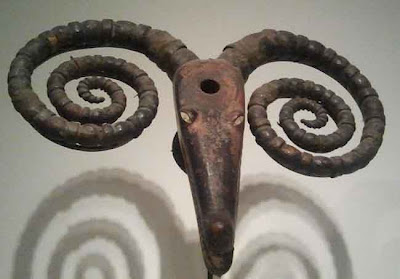
There are several other exhibits I rush through, the African facemasks being a great one. I snap some pictures for future reference for my own cultural appropriation purposes, should I ever care to write fantasy.

Then onto the Empire Builder. Supper is with three gentlemen who have been travelling extensively by rail, clear enthusiasts. They exchange the relative merits of particular trains and routes. On of them is a piano tuner, and we have a great conversation about mentoring, the arts, Seattle, and life.
Not much writing done today. But an excellent holiday.
Subscribe to:
Posts (Atom)