"Rendell began her writing career as a reporter on an Essex newspaper. However, she was forced to resign after filing a story about a local sports club dinner without attending. Her report failed to mention that the after-dinner speaker had died half-way through the speech."Okay, bit sorry for her that people STILL going on about it 50 years later, because really, after 60 novels, I think you should have earned the right to have lived that down. But on the other hand, pretty much best example ever of god telling a writer to stop messing around with the day job and get writing.....

Writing advice and commentary from the editors at Essential Edits / SFeditor.ca
Saturday, May 2, 2015
Ruth Rendell Obituary
BBC news this morning carries obituary of Ruth Rendell, dead at age 85. She was a much beloved and highly successful mystery author, but I have to say that I loved hearing that her career as a novelist started when her career as a journalist ended with a huge FAIL:

Wednesday, October 8, 2014
More Effective Use of Social Media
I was just handed a lesson on social media by my Faculty's communications officer, so I thought I would share it with SFeditor.ca readers.
Saturday, I received an Aurora Award (see previous post). Here's what I (re)-tweeted at the time about getting an Aurora Award:
@Runte scores an Aurora Award at #vcon
I retweeted someone else's live tweet partly because I was in a hurry (I was on a panel right after the awards ceremony) and but mostly because retweeting someone else's tweet felt somehow (i.e., irrationally) less braggy.
There was not a lot of response to this tweet, but tweeting about the award again seemed, you know, worse than braggy. I don't like Twitter streams where people keep repeating announcements about their upcoming books or whatever, so didn't want to be that guy. But on the other hand, really DID want to adveritze that I had received the award, and no one seemed to have noticed my first (re)tweet.
When I got to work Monday, I thought I should mention to the Faculty's communications officer that I had received an award on the weekend, because we're supposed to, and because I thought there was a chance she would put that in the Faculty Twitter feed. And she did, but here's how she tweeted about it:
ULethbridgeEducation @ULethbridgeEdu · Congrats Dr Robert Runté! Recipient @PrixAuroraAward for work on speculative fiction http://bit.ly/1vJnXcO #uleth

Thinking her version might be slightly more effective.....
So, deconstructing here, she grabbed a picture of me from her files, slapped that onto a powerpoint slide; looked up the paper to grab a suitable quote for the target audience (i.e., Faculty of Ed students and faculty), used a couple of different typefaces, and ta-da! Since she had this out within an hour of my telling her, that's that max time she could have spent on it, but I'm guessing she had other more important stuff to do at the same time, so probably a lot less.
I've tweeted text I have thought worth quoting, and announcements, and I've tweeted photos, but um...feeling bit stupid that it never before occurred to me to make a custom slide to combine the interesting quote with the announcement on a strong visual.
Well, duh! This is freaking awesome!
And the result of her tweeting this on Faculty stream was a wave of new twitter followers on my twitter feed....
So from now on, any time I send out an announcement, I'm figuring out some kind of interesting tag line, and putting it out as a visual.
My apologies if this is obvious to everyone else, but thought I would share a lesson learned.
P.S.: My faculty's communication expert is Darcy Tamayose who is herself a published author
Monday, October 6, 2014
Aurora Award
Surprised and delighted to have won an Aurora Award this year [for “Why I Read Canadian Speculative Fiction: The Social Dimension of Reading”, Scholar Keynote Address at ACCSFF ’13, Toronto and subsequently published in Recent Perspectives on the Canadian Fantastic: Selected Papers from ACCSFF. Allan Weiss, ed. Jefferson, NC: MacFarland, 2014 (in press).]

All this year's winners (front) and presenters (backrow).
My turn to present: Rich Leblanc accepting on behalf of On Spec Magazine
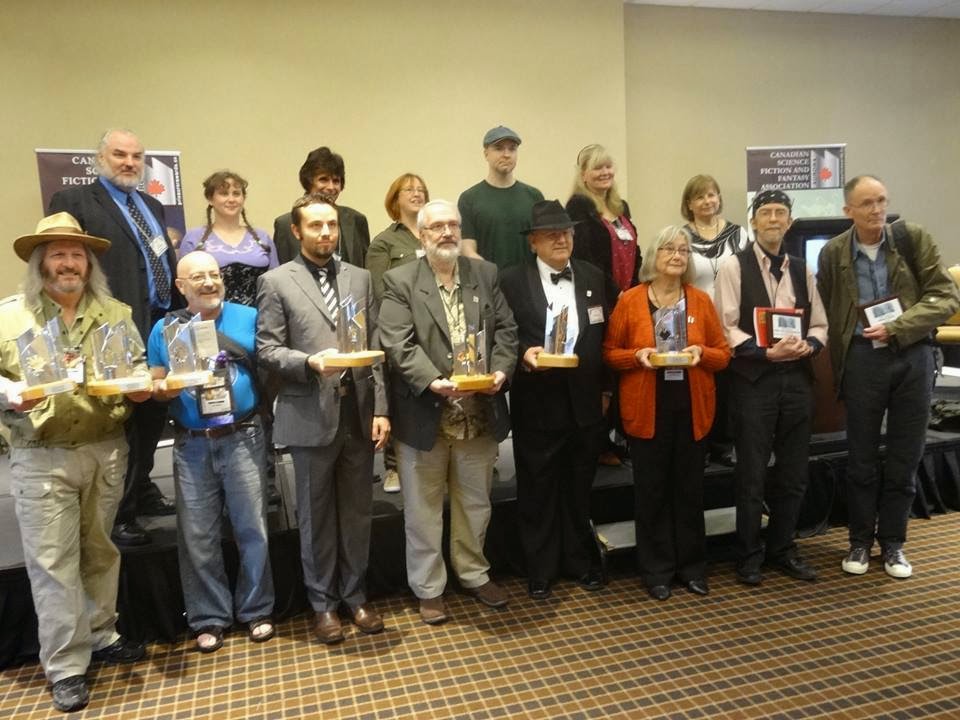
All this year's winners (front) and presenters (backrow).

My turn to present: Rich Leblanc accepting on behalf of On Spec Magazine
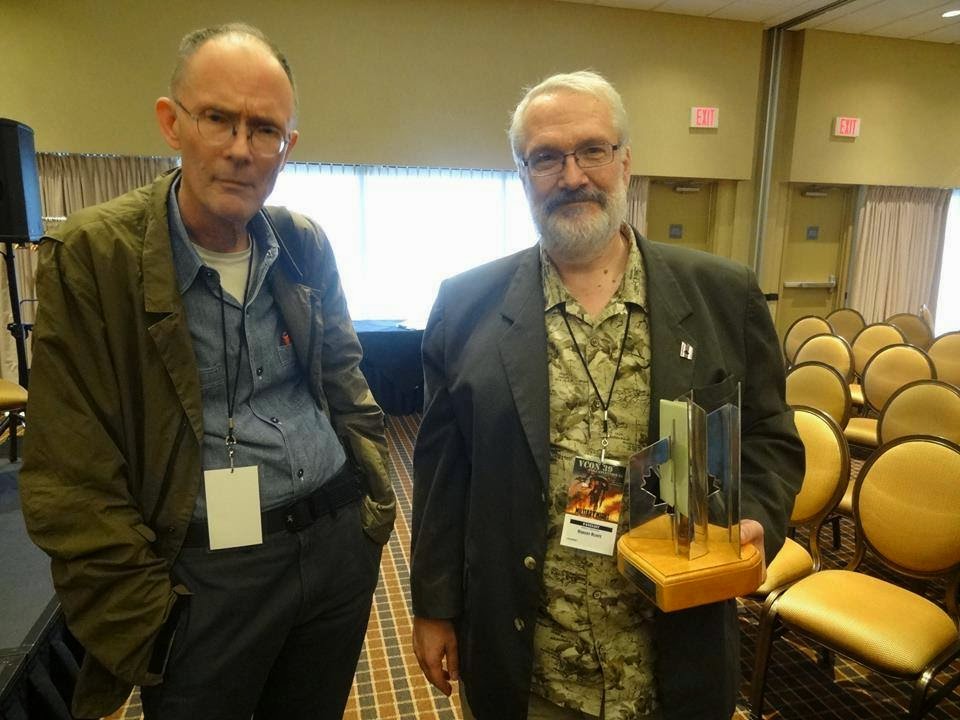
Legendary author William Gibson, who was inducted into the Canadian Science Fiction and Fantasy Association Hall of Fame (along with Spider and Jeanne Robinson; Spider is second from right in first photo) and me, showing off my Aurora Award.
Another highlight of the Aurora Awards ceremony (presented this year at V-Con 39 in Vancouver) was when Al Harlow (Lead singer for Prism) presented the Aurora Award for Music, which went to Chris Hadfield for his performance of Space Oddity — in, you know, space. Thought getting Al Harlow as presenter was pretty cool.
Also glad to see Frank Johnson (in tux in middle of first photo) receive recognition for his trophy design and 23 years of making them for the Association. I often felt that the trophy's unique design significantly added to how seriously people take these awards —makes it really worth getting one.
Friday, September 19, 2014
Estate Planning for Authors
Got my copy of Writing After Retirement: Tips by Successful Retired Writers [edited by Christine Redman-Waldeyer and Carole Smallwood. Lanham, Maryland: Scarecrow Press (Imprint of Rowman & Littlefield)] with my chapter, "Estate Planning for Authors" in the mail yesterday. My suggestions are pretty basic, and come with the disclaimer that I am no lawyer, but hopefully get people thinking about how they want their literary legacy handled after they're gone....

The other 26 chapters in the collection are filled with tips on how to write by successful authors from across a variety of genres and communities. Together, they provide a pretty realistic portrayal of the challenges / obstacles aspiring writers face. This collection is aimed at writers starting after retirement, but most of the advice would be applicable to everyone.
Friday, August 29, 2014
Finding your voice.
This New York Times article by Lev Grossman, "Finding my Voice in Fantasy" is a good example of what I have been arguing for years: that trying to write "literature" is a sure way to fail as a writer.
It's not that I have anything against literature, even though I do sometimes mock CanLit for its depressive tendencies and for its literary pretensions. When I was a judge for a major literary award a couple of years ago, I was shocked how all 33 nominees seemed to be the exact same story. The story I thought should win was brilliant-- moving but with an undercurrent of self-deprecating humour, and it used (what I now think of as) the CanLit story structure perfectly. It wove flashbacks seamlessly into the ongoing narrative so that the reader finally put all the pieces together for an actually meaningful insight right at the climax. But the problem with the rest of the entries was that, reading all 33 stories in a week, I realized they were all using the exact same formula, the exact same structure. The other authors were all trying to write that one story, but for the most part, failing miserably. It was as if they had all completed the same classroom exercise, but only one of them actually 'got' the assignment.
Which is, I believe, almost what happened. I bet each of those small lit mag authors had attended the same university courses--I don't mean the same campus or at the same time, just that they all, as English majors, probably read the same general cannon. The implicit theme of every English course is, "This — this set of stories right here in this syllabus — is literature!". Maybe "Literature" with a capital "L". The problem is, if you tell a bunch of aspiring young writers that this is literature, than that's what they are going to try to write. Which is fine for the one out of a hundred for whom that particular structure/ content/ approach is appropriate, the one percent for whom it comes naturally, for whom it reflects their vision and voice. But for everybody else, it is a distraction, a mistake.
For a decade I worked for the Student Evaluation Branch of Alberta Education; that is, the people who designed, wrote, and supervised the marking of the provincial exams. One of my jobs was on the team researching why some students scored better than others. One of the research findings was that students who scored 5 out of 5 on the English essays had a strong voice, that they said what they actually thought; whereas those who did badly tended to write what they believed their markers wanted to hear. These students never did better than 3/5, but when faced with the need to improve, doubled down on sucking up to the markers, rather than taking the risks they needed to actually succeed. Similarly, the weaker papers often went for convoluted sentence structures and a horribly inflated diction in the hopes of impressing the markers, though these characteristics were the very things undermining their score. The bottom line is that, in attempting imitate the style of the writers and critics they were reading, they gave up whatever voice they might have had, whatever command of language, style and content that might otherwise have been at their disposal.*
I frequently see the same thing with manuscripts from adult clients: English majors who have a fixed idea of what 'literature' ought to be like, even when writing genre fiction; who try to be Margaret Atwood rather than who they are. The thing they don't seem to get is that we already have Margaret Atwood and have little need for another. Trying to be Atwood, they will never be anything other than a pale imitation; better they be a first class, original them. What this country — what this world needs — is more original voices: more original literature, more breakthrough books — not more imitations of existing tropes and authors. By all means read all the literature there is, but never ever try to write like that; or like anything. Just write. What one reads undoubtedly influences one's own style and ideas. That's fine. Read widely and let it all settle into your subconscious. But do not consciously imitate someone else, whether someone identified as a 'literary giant' or someone 'commercially successful'. Never listen to anyone tell you what or how you should write, whether it is to be literary or to get rich. That way lies mediocrity, frustration, and failure.
(*See, for example, Runté, Robert, Barry Jonas and Tom Dunn. "Falling Through the Hoops: Student Construction of the Demands of Academic Writing," in Andrew Stubbs and Judy Chapman, eds., Rhetoric, Uncertainty, and the Unversity as Text: How Students Construct the Academic Experience. Canadian Plains Research Center, University of Regina, 2007.)
Friday, August 22, 2014
They Have To Take You In
.jpg)
Sept 11 is the launch of the anthology, They Have To Take You In, in which my story, "The Missing Elephant" appears. The anthology is edited by Ursula Pflug and is a fund raiser for the Dana Fund:
-
The Dana Fund was created in July of 2010 at the Canadian Mental Health Agency (CMHA HKPR) in Peterborough Ontario, at the suggestion of friends and family who wished to make donations in her memory. Dana Tkachenko inspired many people through her own experiences of struggling against tremendous obstacles and succeeding in creating a stable and fulfilling life for herself and her family. Dana’s memory is honoured through the Dana Fund, by dedicating donations to the cause of supporting young women and families in transition, experiencing similar challenges, who could benefit from some help along the way." - Gordon Langill
Launch: Thursday Sept 11 7-9PM
The Theatre on King
159 King Street, Suite 120
Peterborough, On.
K9J 2R8
705-930-6194
contact@ttok.ca
Saturday, August 16, 2014
When Words Collide Festival, 2014
Once again, I really enjoyed When Words Collide writers/readers convention. I always love the convention itself, but this year I also took in the pre-conference workshops. The first day-long workshop was presented by Adrienne Kerr (Senior Editor at Penguin Canada) followed the next day by two half-day workshops by Mark Leslie Lefebvre (Director of Self-Publishing and Author Relations at Kobo). Both sets of workshops were insider looks at the publishing industry. What I absolutely could not believe was that the workshops were only $40 a day, for speakers that could easily command ten times that much. Randy McCharles and the WWC Board are committed to keeping things affordable for writers, so only charged enough to cover the costs of the conference space for the workshops and the hotel expenses for the speakers; both speakers donated their workshops for free. Hats off to everyone concerned!

At a break in Adrienne Kerr's (Senior Acquisition Editor, Commercial Fiction, Penguin Canada) day-long workshop at When Words Collide Festival, Calgary, Aug, 2014. L to R: Ron Freidman, Calgary SF author; Connie Penner, Lethbridge author who recently signed with Five Rivers; editor and author Elizabeth McLachlan; Robert Runté; Five Rivers author Susan Forest; Canadian SF author Robert Sawyer; and WWC convention chair, Randy McCharles.
The actual convention was similarly affordable and wonderful. I was on a bunch of panels, ran a blue pencil workshop, a Five Rivers pitch session (the convention is one of the few places we look at submissions outside our Feb reading period), was one of four judges for the Robyn Herrington Memorial Short Story Contest; and Five Rivers held a seven-book launch Sunday afternoon. So a full working weekend for me, but a very rewarding one.

One sign of how productive WWC has been for me over the years is that one of the books launched at the Five Rivers launch session this year was "My Life as a Troll", first pitched to me at the very first WWC.
I also enjoyed the keynote speakers and their various presentations. Most impressive was Brandon Sanderson. I frankly had no idea who he was prior to WWC, but I sat with him on the first panel of the convention and I thought, "Hey, this guy is really good! I'm going to have to look up this guy's books." Well, he just seemed like a regular guy; if anything, a bit nicer than usual, the sort of guy you'd really like as a neighbour. No pretensions at all. And then I heard him talk, and well, he'd be a totally awesome neighbour. Am definitely going to have to pay more attention to his books, if his public speaking is any indication of his talent.
I also had opportunity to hang with some of the Five River authors, author/editor friends from across the West, and so on. What makes WWC better than most other similar conventions is the cross-genre nature of the programming. I met so many other interesting writers, including for example, Sarah Kades, a romance writer who I would never have encountered in my normal work week since Romance is one of the genres neither Five Rivers nor I take on. What a positive, upbeat person: she actually convinced me to take a copy of her novel. And similarly, I connected with a bunch of mystery writers (great for Five Rivers new mystery line) and a couple of CanLit people...just marvelous networking opportunities at every turn.
I've already registered for next year, though the dates may conflict with a family obligation that would take priority. Well, the $45 advance membership is worth the risk because the convention sold out well ahead this year, and is likely to again next year in spite of its again moving to a larger venue. I will certainly go if I have any opportunity to do so.
Next up: I'm planning on going to V-Con (Vancouver) in October, the gods willing.
Subscribe to:
Posts (Atom)