Spoiler alert: Chucking the whole project is not the solution.
Rob is talking about book publishing, but the same advice applies to theses and dissertations, just change "editor" to "supervisor" in the article, and it applies.

Writing advice and commentary from the editors at Essential Edits / SFeditor.ca
Spoiler alert: Chucking the whole project is not the solution.
Rob is talking about book publishing, but the same advice applies to theses and dissertations, just change "editor" to "supervisor" in the article, and it applies.
https://www.youtube.com/watch?v=v-v06fHzxMg&list=PLYyla3aTwM9R5f3nVHfTficSyOHajIIZj
Blake concludes by saying "Now, this isn’t a complaint article about editing clients. Rather, it’s meant as a curtain-parting glimpse into what editors deal with in terms of unprepared, underprepared, or naive clients. It’s what not to do when working with an editor."
He goes on to say, "Additionally, many of these 'monsters' come by it honestly. Because they don’t live, breathe and eat writing and publishing as editors do, they just don’t know what’s conventional or expected. Most editors understand this and are glad to help new authors learn the ropes—so long as the author is receptive to expert advice."
Of course, most clients are not like those described. Most are reasonable people looking for expert advice on their manuscript and open to input to ensure their manuscript is as good as it can be. They are happy to learn about the process and to identify the strengths and weaknesses of their writing so they can eliminate any bad habits for next time, and pleasantly surprised how good their writing is after an editor as been over it. The editor-client relationship is almost always positive, Blake's occasional monster notwithstanding.
https://www.louiseharnbyproofreader.com/self-publishers.html
on topics such as How to Master Point of View, self-editing, children's books, indexing, and so on. Worth a look!
Despite the splash caused by self-publishing superstars such as Amanda Hocking and EL James, the average amount earned by DIY authors last year was just $10,000 (£6,375) – and half made less than $500....
Romance authors earned 170% more than their peers, while authors in other genres fared much worse: science-fiction writers earned 38% of the $10,000 average, fantasy writers 32%, and literary fiction authors just 20% of the $10,000 average.
...
Self-publishers who received help (paid or unpaid) with story editing, copy editing and proofreading made 13% more than the average; help with cover design upped earnings by a further 34%.
Read the full article here: https://www.theguardian.com/books/2012/may/24/self-published-author-earnings?CMP=share_btn_fb
Note that the 'average' (i.e., mean) was highly skewed by a handful of high earners. The mode was closer to $500 and a quarter did not earn back their costs. One should probably start with the expectation of making less than $500 on one's first book...
I do know self-published authors who are making a living, though. Krista Ball comes immediately to mind, since she is also one of my favorite authors. But she had a long term strategy and really works at both the writing and marketing...Nobody could say she had found a get-rich-quick scheme. If you're in writing for the money, I think you're in the wrong business. There are a lot easier ways to make a living. But if you're in it for the love of writing, yeah, you have a shot at making...$500.
It only makes sense to seek professional editing if one amortizes the cost over not just one manuscript, but over one's whole career—what one learns from having one's first book edited should show up as a better first draft of #2, and getting #2 edited teaches you how to write book #3 and so on. Editing gets less expensive as you go because your manuscripts start out cleaner, and so take less time to edit. That's theory, anyway. Doesn't always workout that way--being creative, authors can always come up with new ways to screw up a manuscript. But I for one like to think of myself as an educator as much as an editor for any particular manuscript.

Essential Edits will be engaged at Word on the Street Lethbridge in three ways:
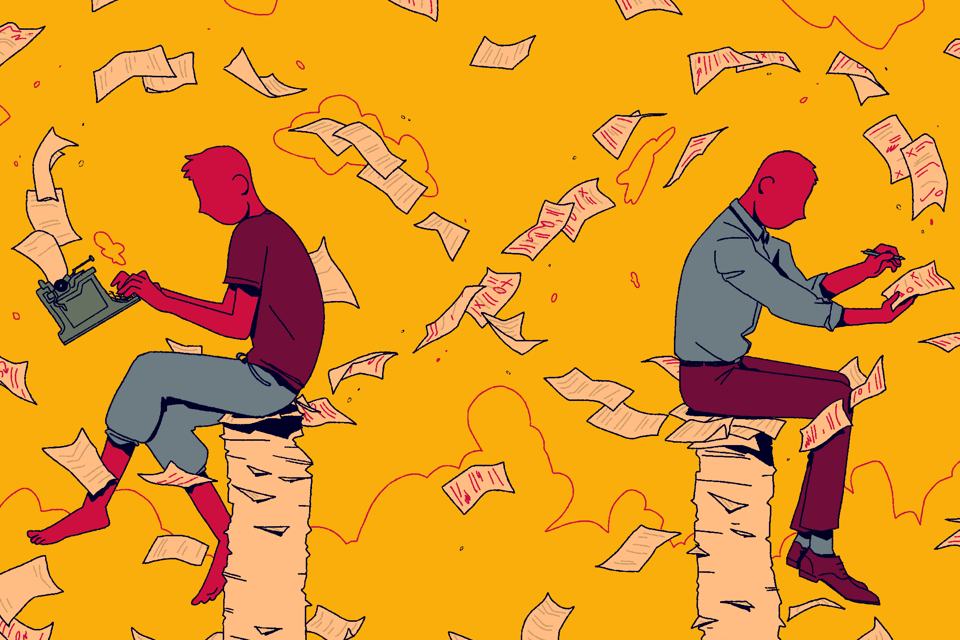
Great article from August 2017 The Atlantic on The Book He Wasn't Supposed To Write". My favorite bit is where the author asks his editor why the editor was so rough on the initial draft/submission, and the editor replies,
“Sometimes my job is to be an asshole,” he explained with equanimity. I wasn’t startled at this. At one point on an earlier book, when I told him how stressed I was feeling, he had replied, a bit airily, I thought, “Oh, every good book has at least one nervous breakdown in it.”
And a second great quote was:
The first draft is for the writer. The second draft is for the editor. The last draft is for the reader.
Seems about right to me.
Highly recommend the whole article, especially for authors who are feeling picked on, and editors who feel they might be pushing too hard.
