Showing posts with label publishers. Show all posts

Thursday, October 17, 2024

Guest Spot on Re-Creative

I'm featured in Episode #58 of the Re-Creative Podcast.

Hosts Joe Mahoney and Mark A. Rayner invited me to come on Re-Creative, the podcast about art and writing that inspire writers. I took a long time to think about which writer or artist had had a big impact on me, but they had already talked about Den Valdron's The Mermaid's Tale and Douglas Adams, and I was debating amongst so many other possibilities (Terry Pratchett, Samual Marchbanks, Dave Duncan, Guy Gavriel Kay, Shane Koyzan, Lois McMaster Bujold, etc etc) that I just couldn't focus: until I read R. F. Kuang's Yellowface (See my text review). I could not shut up about how brilliant and relevant Yellowface is, a must-read for every aspiring writer, so that became the natural topic to propose to Mohoney and Rayner.

We also talk about a bit about my writing, editing, and breakfast.

Monday, May 27, 2024

A Review of R.F. Kuang's Yellowface

I have just finished listening to the audiobook of R.F. Kuang’s Yellowface (not to be confused with the novel by Henry Hwang) and I’m completely blown away. It is the most brilliant novel I’ve come across in a decade and the best about writing and publishing ever. Anyone interested in writing or editing or publishing has to go read it, RIGHT NOW--or better yet, listen to the excellent audiobook narration by Helen Laser.

First and most obviously, it’s the most thorough, balanced, nuanced discussion of cultural appropriation and ‘representation’ I have ever come across. Every perspective is covered by at least one character in the novel, so we hear all the arguments, counter arguments, and the often subtle niggling underlying issues that arise to screw up even the most confident proponent of any side. It’s awesome.

But for most of us, all that is secondary to the thorough evisceration of the writing life and the publishing world. It alternates between wincingly funny and painfully accurate. Everything from writer’s block to the maddeningly brutal impact of social media on one’s confidence is laid out in excruciating detail. Every wonderful and painful thing that can happen to one navigating their book through agents, editing, book tours, readings, interviews, and initial sale numbers is laid out. I can’t think of anything that has happened to me as a writer, editor, working for a publisher, or listening to any of my author friends/clients’ anecdotes that doesn’t turn up sooner or later in this novel. If you ever had questions about what happens after you finish your novel, good or bad, this novel lays out what it FEELS like, second by second. Absolutely brilliant!

Maybe a touch discouraging at times, but forewarned is forearmed, eh?

But wait, there’s more!

Yellowface is the best example of the use of an “unreliable narrator” I have ever encountered. I love unreliable narrators and have written/published a bunch of flash stories using the technique myself, but I have NEVER seen a writer able to sustain that for an ENTIRE novel. It is a tour de force performance. The closest I have ever seen before is the classic noir film, Detour, in which our narrator keeps telling us he had no choice but to make the choices he does, even though it’s obvious to the viewers these are really, really bad choices. Yellowface’s protagonist, June Hayward, is similarly inventive in coming up with rationales for her questionable choices, and Kuang convincingly portrays Hayward constantly slipping into believing her own propaganda, how Hayward constantly sees herself as the victim. We have all met people who do this, and I suspect we’re all guilty of it ourselves sometimes, but watching Hayward cycle back and forth between guilt and rationalization is a compelling case study.

Kuang makes Hayward a sympathetic character with whom we can identify, even though she’s being kind of awful. Because we get it. Writing is hard! Publishing is harder! And it’s all totally unfair! One has so little control! We can see why Hayward is more than a little tempted, and how she gets trapped once she starts down her particular road.

How much do you want to read a book on the writing life, publishing, the technique of unreliable narrator and the modern issue of representation/cultural appropriation? What if we threw in, absolutely free, a section on what it’s like to teach writing?

Author Kuang assassinates every mean and useless writing coach any of us have ever had in her portrayal of Hayward’s good intentions versus how the class actually goes. Hayward’s complete lack of self-awareness in her plagiarism of cliched workshop techniques and her shift from mentor to monster is howlingly funny— ‘howling’ because I was wincing the whole time.

[It reminded me of a long-since departed colleague who taught writing workshops for years, even though he had never published a single word in his life, never finished a draft, merely attended so many workshops he was able to reproduce them verbatim. It literally never occurred to him that stealing other people’s exercises is, you know, plagiarism, and that his workshops were entirely inauthentic and inappropriate as he had no personal experience with which to respond to questions. And even real writers can turn mean under the guise of being ‘brutally honest’ with students about their work. (Indeed, I can think of one example where the professor was so damaging, his students so traumatized, that they processed their PTSD by banding together to start a magazine, now in it’s 35th year.)]

Kuang is obviously familiar with such colleagues and finally got the chance to skewer them here. The whole thing is only a single chapter, but nails an entire industry to the wall.

My all-time favourite scene, though, is when Hayward is working with her editor and together they completely undermine the novel Hayward has stolen and now rewritten. The whole point of the original is to represent a little-known historical event through an own-voices account. But the editor pushes Hayward to up the role of the white saviour characters (so ‘readers can better identify’ with the story), and calls for Hayward to downplay some of the crucial cultural elements (that ‘readers won’t care about’). Hayward, of course, has no problem with that at all, believing she is improving an otherwise likely unsalable book. Again, neither character gets the irony of how outrageously racist they are being, how they are destroying the entire purpose of the original. This one very brief scene cuts to the heart of how the lack of representation and the ongoing cultural appropriation remain key components of the industry among legacy publishing. It’s hilarious and gut-wrenching and so accurately portrays the subtleties of the issue, I am left wondering how many readers will miss the scene’s significance entirely.

The whole book is like that: each scene blows up some aspect of writing, publishing, movie options, social media, fickle audiences, families, and cultural portrayals. Kuang is a satirical genius.

But wait, there’s more!

In addition to all these unbeatble themes and insights, Kuang throws in a page-turning, edge of seat narrative, so filled with unanticipated twists and turns that it leaves the reader breathless. Whenever I thought, ‘Oh, well, Kuang has beautifully made the case for ___, there’s no possible response to that’, Kuang switches gears and we meet a character who demonstrates why that argument was full of holes, why this other viewpoint makes perfect sense (at least to those who hold it). Anytime we or the characters start to get comfortable, Kuagn throws them (and us) down a completely new rabbit hole. Each new development pops up out of left field! The only thing we ever know for sure is that things are going to get even worse for June Hayward.

I laugh-groaned out loud at the penultimate resolution because it was completely, outrageously believable, but then Kuang threw that one out as well and pushes us to the very edge. No spy thriller could come as close to making my head spin as did Yellowface.

In the end, we as readers are left questioning everything we thought we knew about publishing, and more importantly, questioning every decision we have ever made about which books are worthy of our attention, why we actually choose to read what we read.

Act now, and for no more than the price of the hardcover, you can receive the audiobook voiced by Hellen Laser. Seriously, I recommend Laser’s performance over trying to read this yourself. Laser gets every nuance, every subtlety of Kuang’s purpose and carries the listener along past the bits were I might have been tempted to put a print copy down as 'too much' to cope with. One can’t “Yes, but...” the text if it is being spoken and the speaker just carries on.


My apologies to readers who are too young or not Canadian and may not be familiar with the ‘but wait’ format of the old K-Tel ads. I wanted to portray the same level of excitement, if not the dubious quality of most infomercial products

I confess that parts of the novel came a bit close to home for me, as following the passing of the late, great Dave Duncan, I have half a dozen of his partial manuscripts on my desktop to finish, though I came by them honestly. And I have run a lot of writing workshops/courses in my day and have been guilty of advising authors to take or add in this or that element (though not cultural ones, I don’t think) if they wished to increase the book’s commercial potential. I have even confronted own-voices issues of including trans themes or characters not of my culture in my own writing. Reading Kuang has helped me articulate what I’ve been trying to say on these matters in a more articulate way, and appreciate the way Kuang has shown that none of these have clear cut lines.

Though clearer than June Hayward believes....

Thursday, May 2, 2024

No One Buys Books

An excellent article by Elle Griffin summarizing the nonfiction book, "The Trial" about the failed merger of Pengin and Simon and Shuster. (The end result was Simon and Shuster being bought up by a rapacious venture capitalist corporation that is in the process of pillaging it's assests, a much worse result than the merger would have been.) Anyway...the article provides a careful and detailed (albeit, depressing) analysis of the publishing industry. Worth a read if you haven't already seen links to it on social media.

https://www.elysian.press/p/no-one-buys-books?utm_source=profile&utm_medium=reader2

Saturday, August 6, 2022

Inside the Publishing Industry

Fascinating article here on the book industry at the hearings on the proposed Random House merger with Simon and Schuster...if the merger goes ahead, we'll be down to the Big Four:

Antitrust trial puts book publishing industry in the dock;— by HILLEL ITALIE Associated Press

Wednesday, July 15, 2020

Bundoran Press Closes

Yet another Canadian speculative fiction press has closed. Bundoran Press has been around a long time,  with the current owners taking over from Virginia O'Dine in 2013. Under authors Hayden Trenholm, Elizabeth Westbrook-Trenholm and Mike Rimar, this latest incarnation of the company published 4 anthologies and 20 novels, racking up awards and nominations. The press can take pride in its illustrious history and the professionalism and integrity of the publishers. The press is also to be congratulated on taking the decision to wrap things up on a high note.

Friday, May 22, 2020

Five Rivers Publishing Closes

Lorina Stephens today announced the closing of Five Rivers Publishing.

The press, unlike so many others, did not fail. It was in fact thriving, but family issues related to Lorina taking on eldercare made it impossible for her to continue Five Rivers Publishing. I am sad to see Five Rivers go, but Lorina’s reasons are altruistic and it was the right decision.

Lorina helped many authors launch their careers, and her belief in me made my career as a professional editor possible. It was an honour and a privilege for me to have been associated with Five Rivers for nearly a decade.

I hope that Lorina is able to continue her own writing. Her own books were, in my view, undervalued. I met Lorina (online) when I was one of the few reviewers to find and rave about her first novel, and it was through that contact that I became a beta reader on her second novel, then an Editor at Five Rivers, and then Senior Editor. I watched Lorina put more time into the press than into her own writing, and I know she always paid authors, editors, and artists before she took a dime herself.

She put her time, energy, and money into the press because she believed in the community of writers, editors, and artists that she gathered around her. She made it all work in spite of the turmoil in the publishing industry: Five Rivers survived and thrived when other independent presses around her were wiped out.

My hat is off to her vision, her stubborn survival in difficult times, and her promotion of Canadian voices in literature.

I will always be grateful to Lorina and to Five Rivers.

Saturday, May 13, 2017

The Collapse (and Rebirth?) of the Textbook Market

Headline: Nelson Acquires McGraw-Hill-Ryerson

*Sigh*

The continuing consolidation of the legacy publishers into one giant corporation continues apace. Even when the branding remains to provide the illusion of consumer choice, the reality is that there are fewer and fewer publishers to whom authors can submit, and fewer and fewer differences in content for consumers to choose between.

As each publishers seeks to increase profit and therefore market share, it is much easier to do so by buying out the competition, then by predicting which books will sell. As the giant publishers acquire every other imprint, they do so by taking on debt (on the assumption larger market share will pay off the new debt over time). Having debt on that scale requires that each title produce a higher profit margin then when they had no debt, since the debt has to be serviced in addition to all the previous costs, and the only way to do that without moving price point beyond anything consumers would accept, is with economies of scale. Which means each title has to sell in the hundreds of thousands, if not millions. Mid-list authors no longer earn enough to be kept on, and niche markets can no longer be served.

These trends mean publishers can no longer afford to take risks, which means we’re looking at an increased tendency towards lowest common denominator and processed cheese.

In the Sf markets I write for, the number of major imprints (defined here as being available in brick and mortar stores) has fallen from over 40 when I started my novel to about 6 I can think of now. It’s worse in the textbook market—the strains have reached critical mass and the whole damn thing is (in my view) about to crash. My daughter’s textbook for the course she is taking in summer school is $210. But what choice does the instructor have? There are no cheaper choices because there are no other publishers, certainly no cheaper publishers, to choose from. But that is a ridiculous price! That could be a $5 ebook. Students complain, and instructors shrug, but eventually that trend will lead to rebellion. Instructors will (like me) stop assigning texts that students won’t even pretend to read, because they can’t afford to buy them. (My daughter’s roommate showed us her new $1000 bedside table in residence: it was a pile of four textbooks with a lamp on top.)

The collapse of McGraw-Hill-Ryerson in the k-12 market signals the end of the Canadian market—Nelson has made a miscalculation. As the increasing monopoly drives textbook prices even higher, there will simply be no k-12 textbook market left for it to service. The current attitude among the remaining publishers seems to be, well, what are schools going to do? Buy ereaders for every student and buy ebooks? No problem, we control the ebook market too and will make them pay hundreds for an ebook. Schools have to have textbooks, right? Bwahahahahahah!

But that’s not going to work this time. As I may have mentioned here before, I still have colleagues from when I worked in Alberta Learning (Albert's ministry of education) and I am reliably told that Alberta has made the policy decision to completely stop buying textbooks in 2018. That’s it’s. Done. No more textbooks. Because, they said, textbooks are "so 19th century" and no longer serve any purpose.

Textbooks were invented as a way a getting readings into the classroom economically when books were scarce. Previously, itinerate teachers would teach from whatever book they happened to have in their backpacks, but when schools evolved as stable public institutions, they became stable book markets: textbooks were provided via the state to make sure every classroom had a set of books cheaply; then to ensure that every classroom had a set of approved books [the Irish Readers being the first official textbook, whose explicit purpose was to teach Irish school children loyalty to the British Empire and suppress republican sentiments. The first Canadian Reader was the Irish Reader with a new cover on it; it wasn’t until the 1920’s that Irish Reader was replaced with a pro-Canada version]; and then to better organize material by grade and reading level.

And that tradition has continued pretty much up to now. Largely out of force of habit. But the Alberta government has figured out it can save millions by not buying any more textbooks. Because, why bother? Teachers can assign the appropriate entries on Wikipedia, or choose from the millions of pages—or more likely, video*mdash;of appropriate material available on the web. Which will be more up-to-date than any textbook, since it takes years for textbook to go from commission to publication, and so are two to three years out of date by the time they reach classrooms. But schools only renew textbooks for any particular curriculum once every ten years. In Alberta, it's done on a rotating basis, so this year social studies, next year Language arts, and so. That way curriculum committees have ten years to refine the next curriculum based on new research, assigning authors to write the update, arranging with publishers and so on. . . And schools only have to invest in textbooks for one subject per year, keeping those textbooks for ten years while they buy one other subjects per year, by the end of which time those initial texts are both worn out and too out of date to continue using, but then that subject comes up again in the rotation. But the down side has always been that teachers always had to supplement to bring up to date, particularly in social studies and science. Now, skip the cost and inconvenience of the outdated textbook entirely and let teachers use free, uptodate materials by following self-updating wikipedia and various teacher sites. Let classroom teachers custom make the readings for their particular class’ range of abilities and interests, for their particular community and neighbourhood (let’s use the Chinese examples in this class since 28% of this neighbourhood is ethnic Chinese, or use Calgary example for this class in Calgary, etc) for their particular slant. Let math teachers show the Khan academy videos. Why pay for textbooks at all?

So Alberta is done. Alberta is always at the forefront of any trend in Education (the Deputy Minister appointed my former colleague to the explicit position of seeking out innovations and mandated that there wasn’t to be a single innovation anywhere in the world that Alberta wasn’t on top of evaluating, and immediately adopting if it worked) so I won’t be surprised if we’re the first to go textbook-less. . .but um, won’t be the last.

At the university level, I think there is increasingly the opportunity for small presses and independent authors to put out inexpensive ($10) ebooks or ($40) Print On Demand textbooks without any role for these mega-corporations. Let me finish my text on test construction, post it to Amazon, and let individual instructors decide whether it meets their needs for their class. The author makes $5 per copy, instructors get an expensive text for their students, and everybody’s happy. Universities will eventually figure out to count self-published texts towards a professor’s output by asking about sales (i.e., how many other instructors are using their book) rather than by asking how prestigious the publisher is.
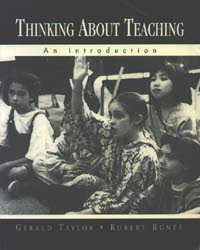

A more boring textbook for Teacher Education than it needed to be.

And we will get much better, much more interesting textbooks. I’ve no doubt already mentioned in previous posts how the publisher of my first textbook insisted on me taking 95% of the humour out because a few of the referees thought I was not sufficiently serious about the subject. So I did take the funny bits out (because I needed the publication credit for tenure), and that textbook tanked after two years—but the stuff I took out and subsequently distributed myself is still in use in some Education Faculties across Canada, 25 years later (and has made me more money than the publisher paid as the advance for the whole book) precisely because they are funny/outrageous. History is BORING, for example, because textbook publishers explicitly remove anything remotely controversial, lest it be unacceptable to some market somewhere: as the saying goes,"if you can’t sell it in Texas, you can’t sell it anywhere.” So no evolution in biology texts, nothing but the bare facts of history, because talking about Louis Riel sells differently in Quebec than Alberta, so just avoid the whole controversy and stick to just dates and indisputable (i.e., uninteresting) facts. Nothing local, because we have to sell the same book to everybody, everywhere. (Or more recently, make only token changes in the new “pick and choose your chapter” textbooks which switch “Alberta” into the sentence from “Ontario”, which are about as useful and meaningful as those kids books you can buy which will print your kid’s name in as one of the character names.) Why you hated every textbook you’ve ever read, but loved every science book by Claire Eamer. . . . Let’s just go with Clarie’s books from now on, eh?

Thus endith today’s rant.

=====================

And now it's another day:
ADDENDUM

Years ago the Social Studies Curriculum changed to include an understanding of the Acadians (specifically, the community of Meteghan, NS) in Grade 2. Unfortunately, teachers found that when they came to that portion of the program of studies, the province hadn't actually gotten around to writing a textbook or providing any other resources about Meteghan. Since I had a daughter in Grade 2 and was an Education professor, I set out to prove to my student teachers how easy it was for a classroom teacher to produce their own curriculum materials--that they don't need to wait around for, or be dependent upon, textbook writers. I produced the "Tigana Learns About the Acadians" website, gathering & filming the material in one day, and constructing the actual website in about two to three weeks of after hours fiddling. And that website got over 80,000 hits by Alberta Grade 2s, until the province got around to producing resources three or four years later.

And that was before YouTube was really a thing! (2006 is so long ago that most modern browsers won't show the .MOV files on that site without some fiddling, though there are workarounds for teachers who are still using the site with their Grade 2 classes.) It is WAY easier to do that these days: which begs the question, why ISN'T producing their own curricular materials an expectation on teachers?

Not every objective in every course, of course, but maybe one thing a year? So that all together we in effect crowd source the whole curriculum? Sounds ridiculous, but it really isn't. Every teacher I have ever met has one unit in their curriculum where they think the text is stupid or the module is missing something key, or whatever...so, don't just complain, upload something better. Then let other teachers grab it or not, based on their classes and their tastes.

There are in fact, lots of websites like that today--some charge teachers to download lesson plans and pay the teacher who uploaded it a percentage, like any textbook publisher, only better because it's custom made by the people who are teaching the concepts, the frontline workers, not someone who hasn't seen a classroom in 20 years. Not that there isn't room for authored books (see Claire Eamer example above) but teachers could regain a degree of professionalism, of professional autonomy, if as a profession they produced at least some of their own collaborative materials.

Or in sociological terms, the separation of curriculum design from classroom teachers reduces teachers to deskilled workers: technicians who implement other's design, which inevitably leads to alienation from the work process. Allow teachers to develop their own resources and you automatically get better teachers and better resources. The Wiki format or the upload/down load for cash format, or just everyone produce their own Youtube videos and self-published books for sale on Amazon...or something new we haven't thought of yet...it doesn't matter, we just need to take charge of our own teaching again.

Tuesday, November 15, 2016

Staying Out of Bookstores

[This was written in response to Paul Cipywnyk's "Where the Ink Meets the Road: Insights from Working in a Bookstore" posted in The Editor's Weekly the official blog of Editors Canada, Canada's national association of editors, Nov 15, 2016. http://blog.editors.ca/?p=3956]


Designed by Freepik

I used to love going into bookstores; now I mostly find them depressing.

As an acquisition editor, I am depressed knowing that the fabulous books I have acquired and edited are not even in the store, because the Indigo/Chapters/Smith/Coles monopoly chain made the decision not to carry independent publishers anymore, when it switched 50% of shelf space from books to cute stuff, because books weren't selling enough. Thankfully, the micro publisher (60 titles and growing!) I work for saw that coming and therefore survived that change when many other Canadian small presses folded overnight when they suddenly found themselves—not just effectively shut out of brick and mortar stores—but faced with six figure bills as their entire inventory was returned to them in one ruthless weekend.

As a critic and reviewer, I'm depressed when I see rows and rows of books in the SF/Fantasy section devoted to TV and movie series; to series written to a single formula; to the exact same book written by dozens of different authors all trying to catch the current fad by writing the predictable processed cheese designed to appeal to the lowest common denominator among consumers. It often feels like the big five publishers are so focused on predictable sell through that they have given up on taking risks, on caring about quality and innovation and promoting new authors. I know that perception isn't accurate, because I've met some of the editors at those big houses and they are fine upstanding individuals who love books as much as I do, and who are doing their best in a tough business. But I miss the days when presses were small and when the acquisition editor and the developmental editor were the same person and made the final decision based on their own tastes and gut feelings without having to worry about shareholders and the marketing department. When publishers were brands that readers could seek out to know that the editor shared their tastes and the reader could buy an unknown author or a new concept because they could trust the editor. Now the consumer can mostly trust that they won't be challenged by what they choose, won't have to think as they read, and will only feel what they've always felt reading the previus 80 Star Trek (or whatever) novels. As a writing coach, I am depressed because 95% of those who approach me for instruction want to know how they can become best sellers, how they can lose their voice and sound like every other author in the store. They want to know which of the current fads they can write to; or, better yet, can I tell them the secret of what the next fad will be. Or, how can they write like a 'gay person' (sic, I quoting here) or 'write black' or First Nations because so many writers guidelines these days say the publisher is open to/especially looking for LGBTQ/diverse authors, and these clients get upset with me when I raise about cultural appropriation. Or, I have to tell them to stop trying to be Margret Atwood (if they have graduated from university creative writing programs) or Robert Sawyer (if they are trying to write commercial genre fiction) because we already have Marget Atwood and Robert Sawyer and what we really need instead is their unique voice and their unique perspective and insight. And then we both get depressed when they ask me, 'Will I be able to make a living writing as myself' and I have to answer, 'Probably not, no'.

As an author, bookstores depress me because as I look around at the thousands of titles on the shelves—even ignoring all the processed cheese clogging the space and only looking at the authors I respect because they are pushing boundaries or allowing their uniquely Canadian voice to guide their writing—even if I just look at the books I love, there are so many more here (just today, not even talking about the turn over month to month—all those pallets of new books arriving each morning that Paul unpacks) l can never hope to read them all. If I cannot possibly buy and read all of their wonderful books, how I can I possibly expect anybody, anywhere, EVER to read my poor effort?

Not that my book is likely to ever end up in an actual brick and mortar store.

Most depressing of all, I can't remember the last time I actually went into a brick and mortar store. (To buy a book, I mean. I remember when I bought my daughter a leather bound notebook, and when I got the wife a coffee mug, and—well, you get the idea.) But I mostly read on my Kindle app or my Kobo, and when I finish a book, up pops a link to the next book by that author; or I take five minutes to search online for another title from CZP (the last great independent publisher in our genre) or from one of the small presses I follow because I know the editors, know the innovative fabulous work they are doing and know I won't find any of their books in the bookstore.

Don't get me wrong: "Where the Ink Hits the Road" is a great piece, and authors and editors should indeed occasionally visit bookstores to check out the real world of publishing. That there are still bookstores and readers at all is a positive thing! Not trying to argue that bookstores are out of date or that big publishers are evil or anything of that ilk. That would be nonsense. (I may be envious, but I'm not delusional, as some commentators on these issues appear to be.) Rather, just saying that we need to be careful when examining where the ink hits the pavement that we don't twist ourselves out of shape trying to figure out how to sell out to get a piece of that action. One should always start from one's own voice (or the client's voice, if you're the editor) and look for the market where that book belongs, and not start from the market and try to fit one's voice to it. The number of writers I've known over the years who've tried to write that Romance or SciFi novel to earn the big bucks, and failed miserably because they didn't even read romance themselves or know SF isn't not called scifi by anyone in the field, far exceeds the number (zero) who made that work for them. The authors I know who became successful all kept to their own voice and only became "overnight successes" after twenty years of nonstop effort to become the best writers they could become, ignoring fads and get quick rich schemes.

And who managed not to get so depressed about bookstores, and the economic realities of modern publishing/distribution, to give up writing completely.

Saturday, April 23, 2016

Copyright Law Changes and the Decline of Canadian Publishing

I have been reacting in various listserve discussions to articles like this one in the Globe and Mail which purport to show that the recent changes in Canadian copyright law are robbing authors of their royalties and killing off publishers. It is, of course, pure nonsense. Correlation is not causation, and the confabulation of copyright changes and troubles in textbook and other publishing is often a deliberate attempt by corporate lobbyists to grab off more than their fair share of the writer's revenues. Michael Geist has written a much better researched and argued piece on the topic than I could, so I refer you to his column "False Alarms: Examining the Misleading Claims About the State of Canadian Publishers". Highly recommended.

Thursday, April 18, 2013

The Small Publisher's Point of View

As a Senior Editor at Five Rivers Publishing, I can attest that this depiction of what life is like for a small publisher is pretty much dead on! Highly recommended reading for any author to see what it looks like from the other side of the desk.

The Publisher/Author Relationship
by James Roy Daley

One reason I signed on with Five Rivers is that the publisher seemed to have a handle on many of these issues and is in it for the long haul. She has steadily grown her business in a business-like way, while many, many others around her have faltered and died. But Daley's depiction of the things that can go wrong if you're not vigilant are absolutely accurate. (My publisher argues that this is more true of old publishing model, and that new POD/ebook model has fewer of these issues.)

It drives me crazy when I read in so many author blogs how publishers are all evil, money-grubbing, rights-grabbing monsters. There are, of course, a number of amateur idiots out there who don't know what they are doing ("Hey guys, let's start a publishing house!") and there are a few big monstrous corporations (run by business boards, rather than editors) that may well be problematic; but most are honest brokers just trying to hold things together. Just as I continually invoke my motto, "The editor is not your enemy", I have to say that in the majority of cases, the publisher is also on your side-- and it would help if you were on his sometimes....

Tuesday, March 12, 2013

On Publishing vs Self-Publishing

"How do you get your books out to your audience? How do you convince an audience that they should buy your books? If you wanted an aspirin, would you buy it from Bayer, or would you buy it from the guy on the street corner who says he’s giving you a better aspirin than a big drug company, except he’s making them in his basement?"
---Sandra Kasturi, On The Advantages of Small Furry Animals in Publishing, Winnipeg Review

Wednesday, March 14, 2012

Good Week for Five Rivers

Today's blog entry from Five Rivers good indication of how much this micro-publisher has grown just this year: Two story collections from H.A.Hargreaves (Canadian SF pioneer); reissue of bunch of Ann Marston's classic fantasy; horror collection from J.W. Schnarr; two novels from Matt Hughes; story collection by Susan J. Forrest; and Michell Plested's Mik Murdoch: Boy Superhero (one of the novels I edited); and a novel by Mike Fletcher. Plus some nonfiction. Not bad output--quantity or quality--for a tiny press. Decent covers too.

Monday, February 27, 2012

Bots, Books and Pricing

Hilarious but disturbing post by Carlos Bueno on how competing computer programs set the price for Carlos' book without his knowledge or participation. And there is a follow-up post on how a fake online bookstore (Geefts) tricks consumers by offering his book below Amazon's price, but doesn't actually have any books to sell.


Totally bizarre. But clear wake up call for authors and self-publishers.

Friday, February 10, 2012

Good week for ChiZine Publications

One of my favorite small presses, ChiZine Publications (http://chizinepub.com/) just signed a deal with Harper Collins Canada to take over its Canadian distribution, and its global digital distribution. (Diamond Book Distributors remains as the distributor for the U.S. and internationally.) Then ChiZine Publications was named "Best Horror Imprint" in Rue Morgue Magazine; then publisher Sandra Kasturi was profiled for "Women in Horror".... So they are having a pretty good week!

CZP is one of my favorite examples of the small presses evolving to fill the gap left by the decline of the previous publishing model. CZP has three things going for it:

(1) publishers (Sandra Kasturi and Brett Savory) who know a great book when they see it -- in contrast to the majors that have abdicated editorial choice to their marketing department's. Readers know that no matter how far out a particular title appears, if Brett and Sandra have passed on it, its got something. I am no horror fan, in fact I generally despise the genre, but I have yet to read a CZP title that I didn't like. Okay, "like" might not be quite the right word, because some of this stuff is seriously wrong but you know, brilliant. So this is an excellent example of successful branding. There are a billion titles out there and its increasingly difficult to find the good stuff. One the one hand, the big traditional publishers try to play it safe in their quest for the big sellers, and so turn out process cheese; on the other, the majority of self-published material isn't even literate. So the most interesting stuff is being published by the small presses, but their output is often uneven. But once one has identified a particular press as a trusted brand -- and CZP is the current best example of a 'never a wrong note' press -- then the press becomes the guarantor of quality that readers require.

(2) publishers who understand the new publishing model -- and Sandra and Brett have practically invented the new model. As publishers of limited edition hardcovers, they play well to the collector market, readers who want books as objects of art almost as much as for their content. Even their paperback editions are things of beauty. And using that market as their base, have slowly, carefully, thoughtfully built themselves into a significant imprint distributed by one of the big players.

(3) publishers who understand community. I think this is one of the key factors that made for their outrageous success story, and one they may not even totally consciously get themselves. I happened to be in Toronto one week when they had an event planned, so dropped in. And was instantly blown away by the community these guys had grown. They have surrounded themselves with a pool of incredibly talented writers, editors, reviewers, and readers. The sociologist in me was fascinated to watch how they turned a reading series into the best author networking opportunity I've seen in years. I watched dozens of horror's best sitting around bouncing ideas off each other, validating each others work, living the writing life. All facilitated by CZP reading series. No wonder they keep finding great new talent-- they're creating it wholesale by creating a community. CZP isn't just a press, its a bloody movement! A school! I know beyond any doubt that future literary scholars will identify this group as a major turning point not only in horror (the horror community world wide has already clued in that CZP is completely revitalizing that otherwise moribund genre) but for mainstream Canadian literature. Kasturi and editor Helen Marshall, for example, are clearly two of Canada's best poets by anybody's standards, and are slowly being recognized as such by the mainstream literary establishment. When was the last time the canlit crowd took horror seriously? When was the last time you actually thought of buying a poetry book. But I tell you, these two...! And they're just the tip of the ice berg. I wish I lived in Toronto to be part of it, or at least to be there with my notebook to document it all, but even way out here in Alberta I can see that the CZP community is becoming THE up and coming literary circle in Canada.

Remember you heard it here first folks!

Friday, December 2, 2011

Editors not always right

A mildly amusing walk through rejection letters received by (subsequently) major writers:
http://flavorwire.com/232203/famous-authors-harshest-rejection-letters To be fair, some of these are early works, and I have always maintained that one role of acquisition editors is to protect writers from publishing their earlier, not-quite-ready works prematurely. And even the editor who rejected "Left Hand of Darkness" (which went on to become a major classic) is making a reasonable decision on what kind of book is right for his press.

But, you know, sometimes we're just wrong.

Thursday, October 27, 2011

Kobo becomes Publisher

News story on Kobo following Amazon's example to become a publisher as well as a book seller: http://t.co/8avHPQxT

What drives me crazy in this media frenzy about Amazon and Kobo etc "cutting out the middleman — the publishers" is that is not what is happening at all. It is a complete misstatement/ misunderstanding of what publishing is and what publishers do. This sort of coverage greatly adds to the confusion around developments in the publishing industry and increases the likelihood of new writers making serious mistakes.

When Amazon announces that it is publishing 122 new books this year, this is not an example of authors going direct to consumers, this is an example of a distributor adding a publishing house to their business. Amazon is doing, with these 122 books, everything that a publisher does — providing for cover art, book design and extensive editing — the whole 9 yards. This isn't cutting out publishers, this is joining the ranks of publishers. It's a development with all sorts of interesting implications: what if Amazon gives preference to its own titles over other publishers titles in its distribution arm. In the long term, the danger is that a few massive online distributors like Amazon may be the only market left standing, with worrisome issues about monopoly and censorship. But it is NOT a story about "eliminating the publisher".

The story that Amazon is "cutting out the middle man--the publisher"— is already long past. Amazon has been selling self-published ebooks for years. Selling self-published ebooks for which the author has found the coverart themselves and foregone editing and book design is an example of cutting out the middleman, because these books have been written but not published. (I would argue that there is an analytical difference between Arthur Slade self-publishing books that have been professionally edited, designed and have professional coverart, and the authors that Krista has been complaining about who put their books up on Amazon without even proofreading their drafts. The former is self-publishing, the latter is non-published.)

For years the public and many beginning writers have believed that publishers took an author's book, distributed it, and skimmed off 90% of the profits in the process. The steps of refereeing, editing, design, marketing, etc remain largely invisible to the public, and mere annoying barriers to many beginning authors. Media coverage of the emergence of publisher-distributors like Amazon is not helping to resolve this confusion, but rather compounds it. The result, I am afraid, is many more authors choosing to 'go with Amazon' by which they will mean uploading their unedited, underdeveoped, manuscripts rather than submitting to Amazon's publishing arm and getting (from all accounts) really good covers and editing....

Thursday, September 8, 2011

Interview on Editing

Interview with me on editing by Mike Plested on his regular Get Published podcast. Mike's questions covered a lot of ground and I think the interview came out rather well-- i.e., he did a good job of editing out all of my more stupid comments.

Monday, August 15, 2011

When Worlds Collide


The When Worlds Collide Festival in Calgary this past weekend was a magnificent success, the best SF convention since Context'91. I participated on seven panels/readings/workshops, to apparently positive reviews. I found three new Alberta small presses I hadn't been aware of before; got to meet half a dozen authors (most notably Krista Ball, Susan Forest and Michell Plested) with whom I have corresponded but not previously met in person; got to rave at Minister Faust who've I met before but haven't seen since he turned professional writer; made a couple of deals for SFeditor.ca freelance work; spent an evening with a Five River's author I am currently editing -- very productive working supper!; raised the possibility of Five River publishing their work with a couple of promising authors; had another half dozen authors pitch their work to Five Rivers, one of whom I actually said yes to her sending a submission. Got to hear dozens of readings by top authors-- again, highlights were Susan Forest's brilliant comedic short story, Bob Stallworthy's poetry and Susan MacGregor's novel excerpt. (I would love to get my hands on MacGregor's novel, but she is already in the process of signing elsewhere.) Was able to take in a couple of other panels on topics I was actually interested in -- in contrast to most other conventions where panels are either on topics that don't interest me, or topics I've been speaking on for last 30 years, so kind of bored with. Writer/editor/publisher- oriented topics here of actual relevance.

My only regret was that I didn't get a chance to really sit down with Robert Sawyer, our paths always crossing as one or other of us was on a way to do a talk; and some other authors I see in various facebook references were apparently there but I didn't run into or perhaps didn't recognize. But then there is always next year...

If this year's event was any indication, I highly recommend next year's WWC Festival to any writers (or serious minded readers) as a great venue to meet/do deals with editors and publishers, to find out what is happening in the field, and to take in some great workshops/panels etc.

Saturday, May 14, 2011

Agents as Publisher

Perceptive column by Dean Wesley Smith on how writers are allowing themselves to be exploited by agents.... (Thanks to Russ Crossley for bringing column to my attention.)

I have to admit, my reaction to agents turning "publisher" was very similar, though Smith writes with a good deal more verve than I could have managed. As the publishing field is revolutionized by emerging technologies, various parties will try to reconfigure the playing field to their advantage. These new 'agent' publishers are a good example of the capitalist entrepreneur trying to insert himself between the producer and consumer to skim off the profit. Given new publishing modalities, there is no need for anyone to intrude between producer and consumer in this market -- an established writer should have no difficulty selling directly off their own website, though I can see a place for distributors such as Amazon. But agents taking 50% of the 'net'? After paying out set up expenses? Smith is correct to rain down derision on such a suggestion.

As mentioned here previously, 'net' is a flexible figure, and there is a long history of Hollywood ripping off creators through creative accounting such that their work never turns a 'profit', even when it earns enormous amounts. That hasn't been a significant issue with publishers up to now, but the agent-publisher contract that Smith reviews is very clearly an example. And the agent-publisher is completely upfront that all the set up costs for the book (cover art, book design editing and so on) are to be recovered off the top -- so the question has to be, exactly what is the agent bringing to the table for his "50%" share of royalties, when the author is bearing all the costs of publishing the book in the first place?

There are two possibilities: First, the agent is acting as the contractor, bringing all the necessary subcontractors --editors, artists, designers, distributors etc.-- to bear on the project. Smith recognizes this role and correctly sneers at the need to pay such a person 50% of your lifetime profits. There are plenty of actual service agencies that will provide these services for a flat fee. Or, the author could simply take on the contractor role his or herself, and hire their own artists and designers and editors, thus be assured that the cover (for example) will meet their own requirements, standards, and personal tastes. Who needs an agent for this?

Second, and a role Smith fails to acknowledge, the agent does bring a level of branding to the product. Presumably, sufficiently famous agents provide a layer of refereeing that could increase consumer confidence. Okay, I can see that. But is that worth 50% of the book's income forever? Not convinced!

For me, the question is simple: What are you getting and what are you paying for it? I am not about to hand over the rights to my book to an agent to publish using my own money. Traditional publishers earn the right to my rights by offering to cover all the costs of publication upfront, and by providing a variety of services (editing, cover art, promotion, distribution) and (usually) by paying an advance on royalties. Their willingness to take a risk on my book, investing a fair bit of capital up front, earns them the right to reap a return on their investment. And their willingness to invest in the book provides the consumer with the assurance that somebody beyond the authors themselves thought the book worthwhile and likely to be of interest to readers. That model has worked well for a long time...Publishers who backed the wrong books went out of business; those who made good calls prospered, along with their stable of authors. I'd still be happy to sell to a major publisher and know I was going to get mass distribution, upping my odds of getting mass sales. Failing that, selling to a small press like Five Rivers or CZP makes sense to me, as they bring a whole range of services to bear, and take on all the financial risk, and provide some branding beyond my own name. But I'll self-publish before I hand over my book to one of these emergent agent-publishers.

Sunday, May 8, 2011

Creative Accounting

Excellent article by J. Daniel Sawyer on how authors (and other creative types) are often cheated out of their share of project's profit through creative accounting. Fascinating stuff. (Thanks to Rebecca M. Senese for bringing it to my attention.)

It is important not to let such articles make us too paranoid, however. The examples from the movie industry do not apply nearly so much to the book publishing industry; and unless you're Stephen King, chances are your books aren't making enough money to make it worthwhile for anyone to go to the trouble of cooking the books to cheat you. Most publishers are pretty conscientious about paying you your 10%, because fudging the books to shave a few thousand dollars off an author's returns would be more trouble than it's worth.

The structure of (traditional) book publishing was such that as long as a few of a publisher's books were hits, they could afford to have others break even and the occasional loser. Recently, for example, a romance writer worked out that her NYTimes hit romance novel earned her about $50,000 and made $250,000 for the publisher (though one has to subtract paper, printing, distributions costs from that, so not sure what the actual net profit would be here). The revenues from all books published are put against all the costs incurred, and the publisher hopes that comes out in the black. In contrast, each movie or TV series is set up as a separate company/project, with it's own debits and credits -- so in that scenario, putting the costs/losses of movie A against the profits of movie B looks like cheating to people who signed contracts based on net profit from movie B. But in the book industry, its just 10% of cover price of your particular title, and everything is just one company, so that is a lot more straight forward.

Or to put it another way, authors recognize that its okay for 90% of the cover price to go to publisher, to cover the costs of printing, paper, distribution, sales people -- but also acquisition editors, copy editors, book designers, cover artists, etc. -- AND the money lost on books on which the publisher took a risk. Because, you know, at some point they took a risk on you....

In my experience, the people who suspect the (legacy) publisher is ripping them off are more likely paranoid than justified. The number of cases where legitimate publishers were ripping off authors are vanishingly small; though of course the vanity press industry is a different matter entirely.

What makes the article about creative accounting relevant to writers today, is that the publishing model is rapidly changing as emergent technologies open all sorts of opportunities. Some of the proposed models look a lot more like movie contracts and are therefore similarly suspect. The fight between Amazon and publishers over the pricing of eformats was a distance abstraction to most authors, but it was precisely a struggle over these sorts of issues -- an attempt to blur the lines between publisher and distributor, with Amazon and Smashwords and the rest trying to grab off a higher % of the net profits by defining themselves as the publisher rather than just a distributor-- that was at the heart of the struggle. This matters to authors in the long run, because, as Sawyer's article cited above points out, it's the 'net' profits that allows space for creative accounting.

Similarly, the proliferation of small press publishers raises the possibility of a greater range of accounting practices -- either through inexperience, or deviousness. It's possible that some of these publishers are less ethical than others. But again, in my experience, most are scrupulously honest and in fact often putting their own finances at risk to ensure authors get paid what they are owed and on time. The few cases where the publisher/editor is of questionable reliability, there are usually plenty of warnings on various blogs, such as Writer Beware. Although authors should adopt a 'buyer beware' attitude towards new presses and do a little research, if a publisher has a stable of happy authors, one should start from the assumption that they haven't decided to rip you (and only you) off.

I have come across a few authors who are sure they are not getting their due, loudly decrying this or that publisher for ripping them off. But whenever I have asked how they know, they say something like, "Well, they say I only sold 320 books last year. I know that many copies sold to people in just my local circle of friends, so they must be lying! I bet I've sold thousands of copies just this week alone!" And so on. Okay, I suppose that's possible -- but is it maybe possible one only sold copies to people in one's circle of friends? Because the average self-published and small press title sells less than 200 copies. One can't really blame the publisher's royalty statements every time one's sales are slower than one might hope.